Written by Kevin Robbie | 4th December 2025
As 2025 draws to a close, the conversation around social value has shifted in important ways. Across Australia and Aotearoa (New Zealand), governments, funders and practitioners are grappling with how to embed social value more meaningfully into procurement, grant funding and impact investment.
The past few months have seen a series of events – in Sydney, Melbourne and Auckland – that each, in their own way, highlighted both the progress made and the challenges that remain. At the same time, new international reflections, such as the UK Government’s recent review of social valuation methods, remind us that the field is evolving globally and that questions of rigour, purpose and practice are more relevant than ever. In this article, I reflect on the themes emerging from these gatherings and what they signal for the future of social value as we head into 2026.
The conversations
In 2025, conversations about social value across Australia and Aotearoa have felt more active, more mature and more necessary than ever. The field is evolving quickly, pushed forward by impact investment, procurement reform, emerging wellbeing frameworks, shared value, more effective corporate social responsibility and the surge in organisations, across all sectors, wanting to understand not just what they do, but the social value they create.
It is timely that the UK government, through a recent rapid evidence assessment of social valuation methods across civil society has turned a stark spotlight back on how social value is defined, measured and used. The report underscores that while there are many valuation tools and proxies out there, there remains inconsistent methodological quality, limited empirical validation and a need for clarity around when and how different tools should be applied. The UK’s re-examination confirms that social valuation is not a plug-and-play exercise – rigorous context, transparency and purpose matter.
This global reflection coincides with four major events I spoke at over the past six months:
- Social Impact Summit 2025 (Sydney)
- Social Value Aotearoa Conference (Auckland)
- Social Traders Convene 2025 (Melbourne)
- IMPACT! Procure with Purpose 2025 (Melbourne)
Together, these gatherings offered a panoramic view of where social value/valuation is heading and what still needs to shift for it to meaningfully shape decision-making. Below are five themes emerging as we transition into 2026.
We have moved beyond ‘why social value?’ – the challenge is embedding it
Across all events, it was clear that social value is no longer something organisations need convincing of. The question has changed – it is now ‘how do we embed social value meaningfully?’ in organisations with different mandates, capacities and pressures.
In Auckland, the focus was on organisational practice, using data to drive better decisions and improve approaches. At Convene and IMPACT!, it was procurement specifically – how to build procurement processes that are robust, enabling and context-sensitive, rather than compliance-heavy or exclusionary. At the Social Impact Summit, the focus was on was on building system-wide capability, across government, philanthropy and the not-for-profit (NFP) sector, to embed social value as a shared foundation for collaborative, impact-driven decision-making.
This shift tells us that social value has entered the ‘doing’ stage and that system design, organisational capacity and culture now matter more than rhetoric.
It was also recognised that is was also important to distinguish between social value and social valuation. Social value is the broader intent to create positive outcomes, while social valuation is the process of assessing, quantifying and monetising those outcomes, which is often audience-specific and not always necessary for every decision.
Shared language matters – and the Principles of Social Value are the anchors
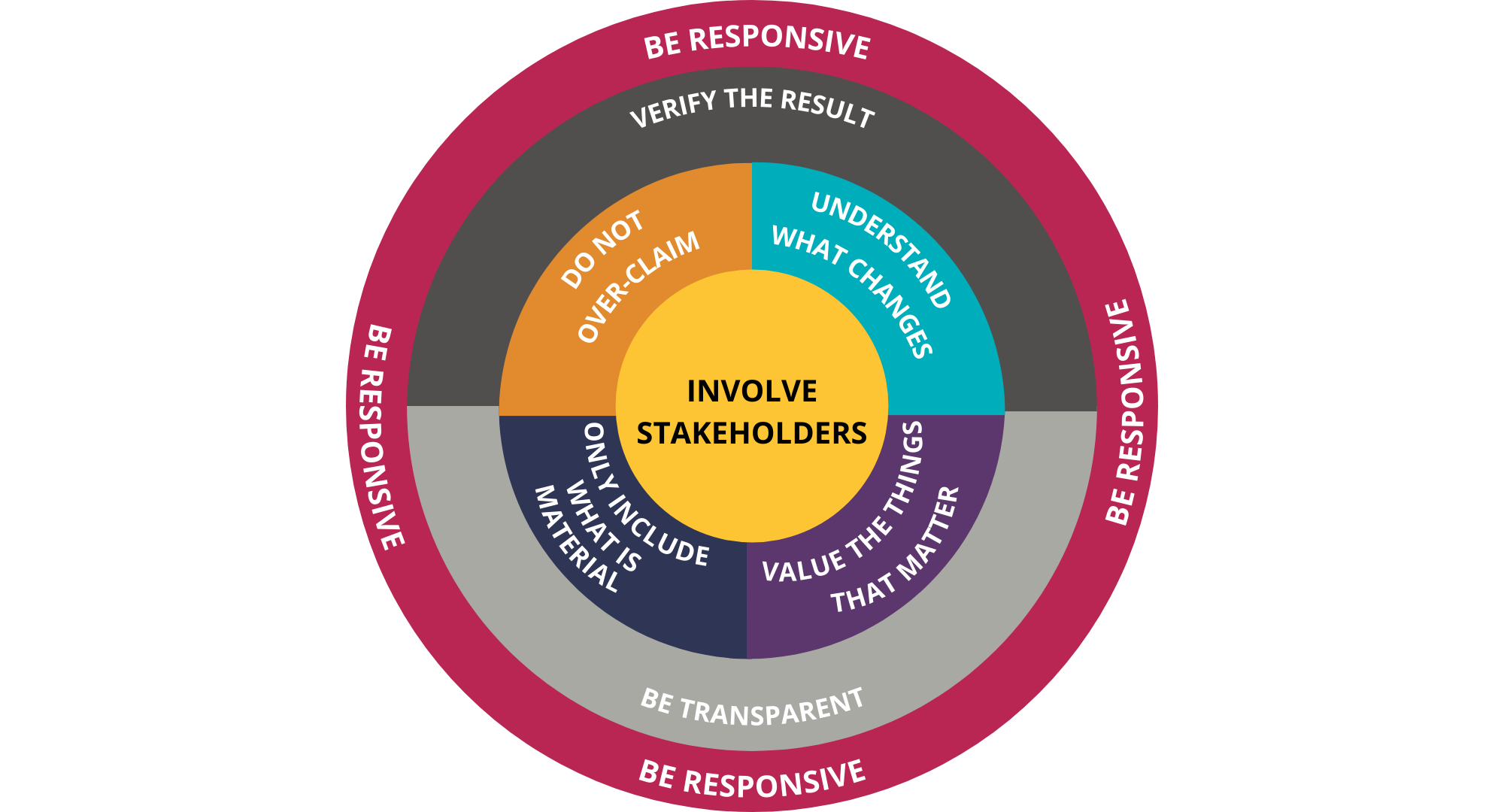
A recurring theme was the need for social value literacy, a common understanding of what social value means and how to assess it. This is where the Social Value International (SVI) Principles of Social Value are increasingly seen as essential. These principles provide a strong foundation for good practice across all sectors and contexts. Any social valuation tool, approach or process should be embedding the principles into how they operate. And for practitioners looking to evolve their understanding of what best practice is, then engagement with the SVI community is a must.
Alongside this, the ongoing evolution of Social Return on Investment (SROI) was frequently referenced. Twenty-five years of methodological refinement have transformed SROI into a rigorous, context-rich, principle-based approach to social valuation. Across events and countries, SROI is emerging as the go-to standard when robust, accountable social valuation is required.
This growing consensus provides clarity – social value isn’t just about metrics or checkbox exercises, it’s about structured, stakeholder-led, evidence-based evaluation grounded in shared principles.
Procurement practice is evolving – but capability building and quality need to be central
At Convene 2025 and IMPACT!, the conversation around both procurement and social procurement showed real maturity. Participants recognised procurement not simply as a transactional activity, but as a potential lever for systems change. But this only works when several conditions are met:
- procurement teams must have capability to assess and value social outcomes
- suppliers must be supported to participate equitably
- procurement systems must avoid over-engineering to the detriment of smaller organisations
- outcomes sought must be realistic, context-specific and resilient
- quality must trump volume or compliance.
The clear message – used effectively procurement can create social value, but only when designed with impact, context and partnership in mind.
Not all tools are created equal but every tool has a role, when used wisely
Within the UK it was noted that there was growing scepticism toward plug and play social value calculators. Many practitioners, across all events, echoed this and warned against thinking that a quick proxy or off-the-shelf metric can stand in for deep understanding.
Yet these plug and play tools do have a place, especially in early decision-making phases such as procurement assessment, assessing grant funding applications or due diligence in the impact investing space. They are useful where light-touch, predictive social valuations can help compare options, screen risk or estimate/illustrate likely social value.
The critical caveat – use the right tool for the right job:
- Use predictive tools for early-stage decisions or comparison at assessment stage.
- Use more robust, context-sensitive tools (like SROI, cost–benefit analysis or social value modelling) when the objective is to evaluate whether social value was actually created or to make a business case for funding or investment.
Clarity about purpose – i.e. when you need speed versus when you need depth – will help social valuation practice mature without overstretching what any tool can deliver.
Collaboration is key to tackling complex, ‘wicked’ problems
A striking theme across the events was how often social challenges were described as systemic, layered, and interdependent. Entrenched homelessness, health, inequality, environmental change, long-term employment exclusion, etc. – these aren’t issues that any one sector can solve alone, they require collaboration across government, philanthropy and community organisations.
It was evident that what’s needed, and what some of the more progressive participants at the events are beginning to build toward, is collaborative commissioning and impact-led design. That means:
- governments, philanthropy, community organisations and social enterprises working together from the outset
- designing with the intended impact for people and place foremost in mind
- focusing on systems and relationships, not siloed metrics
- accepting that outcomes may take time, require iteration and need adaptive governance.
In such a context, starting with ‘social value’ as a procurement checkbox is the wrong move. The right move is beginning with systems thinking, then using social valuation as one of many tools in a broader design and evaluation toolkit.
Looking ahead to 2026 – what the field needs next
If 2025 has taught us anything, it is that social value is no longer a fringe interest. It is becoming a core organising principle across procurement, policy, philanthropy, community development and impact investment. But to make it truly matter, the field will need to focus on:
- Anchoring in shared principles, not just proxies – the SVI principles offer a stable and trusted foundation. As more organisations embrace them, consistency, integrity and accountability will improve.
- Capability-building across the system – among buyers, suppliers, funders and communities.
- Procurement teams, grant makers, governments, councils, impact investors, NFPs and social enterprises all need better social value literacy, better data practices and better tools for evaluation, especially when tackling issues that are complex and long-term.
- Creating trusted spaces for ‘the crucial conversations’ about the future of social value in Australia is needed – something akin to a national forum on social value that is a place where governments, philanthropy, NFPs, social enterprises, evaluators and communities meet, debate, learn and co-create standards, tools and best practice.
The last few months, and the events I attended, show a field in motion, not by accident but by design. The momentum is real. The ambition is evident. And the opportunity is enormous. But it will only be realised if we hold space for the hard questions, commit to collaboration and start building approaches fit for the scale and complexity of the problems we face.